Thursday, March 28, 2013

Fred Lives!


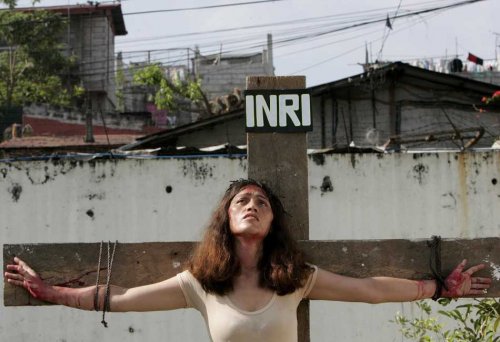
This Easter you may be encouraged to think of someone who gave their life to redeem us.

This is what a messiah is; their life redeems us. And this redemption doesn’t work from the outside but from the inside. The messiah must be one of us so that their life counts as one of ours. That’s why it has this redemptive nature.

How does it save us? It shows us what we can be. Also that means there’s no salvation except through emulation.

From our exploitation of the poor and vulnerable, to our adoration of whatever is powerful, humanity can often seem shitful. Look at the abuse of our children. Look at the idiotic cunning of nuclear deterrence. Look at climate change skepticism, still. We are cruel, and murderous and thick as bricks.

But the messiah figure is different to that. They oppose that. As a human they refuse to be just defined by their humanity. They are kind and wise. They bring joy.

Other than the messiah, we can feel that humanity is worth stopping like a failed experiment, or like an oil spill. These aren’t sensible thoughts. But we feel them some days anyway; Then, because of the messiah… maybe not.

This Easter like every Easter we will be told by some that our one and only messiah is Jesus. I imagine that reflects the experience of the first Christians. I imagine that is why Jesus was celebrated in that way.

You may struggle to see the messianic quality. There are too many Jesus followers who think of kindness and wisdom and joy as secondary issues. They propose Jesus following as attending church, railing against other people’s sins, prayer and praise and obedience to certain biblical laws (though not others). Some can even follow Jesus and cover up the abuse of children; some can follow Jesus and still support nuclear deterrence. There can seem to be little of a redeeming nature there, just more shitful humanity.

Last Easter I wrote about what I think what Jesus’ message was. It’s primarily about God. I think there is something awesome there. However if you don’t, I don’t care. There is nothing in my mind especially gained by “recognizing” Jesus as a messiah or as a redeemer of humanity. The proof of that is history. It’s a crying shame but it’s evident.

Fortunately there is not only one messiah 2000 years old speaking in a language we have to struggle to understand. Instead there are many. Humanity throws up countless lives who respond to whether we deserve destruction with “maybe not”. Malala_Yousafzai, Charles Perkins, Jonas Salk are amongst many others. Your messiah might be someone very close to you (like my partner is for me). Or it might be Jesus from 2000 years ago.
 
I often think of Fred Hollows, an Australian eye doctor. That’s a life to emulate. It’s a life that shows us a path to restoration of a humanity of redeemed value, in the midst of human caused pain.

The important thing to remember is that merely admiring a messiah gets us nowhere. Messiahs that we put the work of our salvation on to are false messiahs. They have become separate from our humanity and can no longer redeem us. Ultimately it is not the messiah that truly saves us but the path they show.


Happy Easter.

Monday, March 18, 2013

Nature and the Unnatural.


Through all the challenges our planet and the human race is enduring in these transformative times, we have such a powerful ally in Nature and more than ever, we need to be collaborating with her in all of her aspects.

The concept of nature as a teacher or ally has a salience to our lives expressed in the above quote by “these transformative times”. I feel, with mounting evidence, that we as a human race must resolve our relationship to nature differently, perhaps even more traditionally.

The calving of continent sized ice sheets are signs from the world of these “transformative times”. The increases in obesity in developed countries are symptoms from our own bodies of the same. “Something is dangerously wrong with our shit” sounds louder and louder all the time and it seems only a fool can’t hear it. Alienation from and antipathy towards nature is a diagnosis that makes some sense of our condition.

There’s a spiritual malaise too that focuses our attention on these material signs and symptoms. We don’t feel well. Sure, it begs the question to say this spiritual malaise is due to our not listening to nature. It’s uncertain if feeling the malaise precedes the interpretation or is induced by it. However that sickening sense of artificiality I feel in the middle of a mall is privately convincing our society has some kind of a problem with nature, as is the healthier feeling I get when bush walking.

But then we encounter our problem of definition. Is a mall really something unnatural in contrast to a preserved stretch of bushland? A clearly built environment, whose light hides the stars at night and whose concrete covers the earth, is still the consequence of choices which could be called natural for humans to make. And if so, aren’t we nature too, as much as trees and kangaroos? Nature, in its broadest sense, can lay claim to be whatever is.

Talking to my five year old by the way, her definition of nature excluded angry stray dogs. Nature was in her words, “everything that was around us and nice”. She initially included as nature cars but then doubted that, houses were more natural, rubbish on the ground was definitely not and trees were nature’s best representation. God was a part of nature too.

In the “adult” conversations I’ve had on this topic, the tendency has been to accept that everything is natural. To justify calling anything unnatural (or supernatural for that matter) we have to do two things. We have to have a source for it, or a logic for it that is outside of nature. Secondly we have to retain that outside status. We can’t allow our concept of nature to grow to include the unnatural.

My adult friends weren’t generally willing to do these tasks with anything my child considered “unnatural.” No-one seemed willing to say that a car or a mall has a source or logic outside of nature and that we shouldn’t ever increase our concept of nature to include that source or logic. Human psychology and society in all their forms were accepted as natural.

To put this another way, most people I spoke to accepted a monism of nature. A monism is something which is indivisible. The effect of this is to render impossible appeals to nature:
“An appeal to nature is an argument or rhetorical tactic in which it is proposed that "a thing is good because it is 'natural', or bad because it is 'unnatural'". – Wikipedia

Appeals to nature are impossible when nature is a monism because moral language is about alternatives which are at least dualistic. Something can be good or bad in moral language. If nature is the whole of reality, then nature can’t be good or bad.

Instead if nature is a monism what makes sense for us to do is to view morality as something imposed onto nature from outside it. As an example the polio virus is natural. It naturally infects children who naturally suffer for it. However the eradication of polio is good (and also natural by the way). What makes the eradication of polio good are values which we give to events which don’t belong to them in any essential way. Specifically we call the suffering of children bad even though it is as natural as anything else.

By the same logic the extinction of tigers is natural. If we are to say it is a bad thing then we have to justify this in a way that doesn’t belong essentially to tigers or the world. We have to create the value from elsewhere such as our enjoyment of tigers or a tiger’s usefulness in their ecosystem, which then must relate to something else of value to us. This is the point where I begin to question whether we have gone astray.

A refusal to deify nature and to identify anything as unnatural helped us with the polio situation but it seems to miss something with the tigers. We seem to be forced down long paths of utlity measuring to say why tiger extinctions are wrong when more useful language lies in my child’s vocabulary. We seem to have gotten to this point because we are unwilling to complete two tasks – to have a source for something or a logic for it that is outside of nature and to not forbid our concept of nature to grow to include this.

I think this is not a decision we have properly investigated. I also think this is a cultural phenomenon which it is very interesting to imagine undoing. Imagine if we did have a conception of an unnatural logic that was seen as different to a natural logic and we refused to incorporate it into a natural logic. As an example we could identify capitalism as an unnatural culture and deny it the same status as natural. We could declare it foreign to the “real world”. Those are the kind of steps we might need to take for the quote at the start of this post to make robust sense.

Are they impossible steps? Would we be better off or worse off for attempting them? I think our reasonable fear is that we will only be fooling ourselves; that all appeals to nature are based on romantic misrepresentations of nature. After all is it evident that capitalism is unnatural or natural? Are we just making an entirely random declaration and if so could someone else equally declare that reading or women in the workforce is unnatural? Is it better given its potential to oppress and hamper common sense to declare the language of natural and unnatural an off-limits moral rhetoric?

Certainly if we are going to come up with a pejorative idea of unnatural we need to do more than derive “natural” from simple observations of nature. If we do that we may end up modeling human behaviour on that of other species which is never going to fully work and in some cases will be just ridiculous. Should we pick off the weak like a predatory cat? Or be as patient as a tortoise?

Natural and unnatural will need to be fairly complicated concepts if we do employ them. They have to speak to everything we feel about the sickness of our lives, the upheaval of our planet’s climate and ecosystems and still retain a sense of who we are as particularly human animals with our human concerns of justice. I share the belief with all the people I spoke to that this is not an easy definition to come up with. Maybe we should just deconstruct “natural” as a propaganda tool without any real hard meaning and leave it at that.

However if we do merely deconstruct the concept of natural with no reconstruction will there be any way of saying that the things which are “around us and nice” matter in and of themselves?  Will a tiger in a computer game be as good as the real thing? Or better even for being safer? In this matter I feel like consulting my five year old is probably the best idea I’ve had on this topic. For her, language is something she is unsure of and prepared to renegotiate, partly at least to feel well with the world. That’s why I want to give the idea of nature as a teacher or ally proper consideration even if it upsets my "adult" thinking. Language ought to be subject to our needs for wellness, not the other way round.

Thursday, March 7, 2013

A preferential option for the poor.


I was recently asked why I often write within or at least around a particularly Christian mythos. It’s a legitimate question. It also has three distinct answers. I’m going to give the most important one, a qualified defense of Christianity, and leave the other two shrouded in mystery. Perhaps I’ll get to them another time.

Christianity is a highly literalized religion. Something in the majority Christian psyche from as early as we have records has been unable to hear phrases like the Son of God without having to imagine a male God literally impregnating a woman. I find that ridiculous. Similarly there are stories of Jesus calming storms, walking on water and even raising the dead with the strong suggestion this could be done by his followers. Given that Christianity did not usher in an era of miracles in which the boat and medicine became redundant I likewise consider these stories symbolic.

There are many ways in which my attitude to the miraculous events of the Christian bible put me outside of normal Christianity. I don’t consider Jesus especially and uniquely the Son of God. I don’t think I can talk to him today in any normal sense of talking. I don’t think Jesus’ triumph over death means they are alive now. That also means that I don’t believe that you and I will be able to chat in a billion years in heaven (or in the other place). You and I will be as dead in a billion years as Jesus. Meanwhile Jesus’ biological father, possibly Joseph or possibly some random raping roman soldier will be even deader.

Given the literalism of Christianity and my statements of belief in the above paragraph it’s pretty simple to say I am not a Christian. The cracks in that certainty appear when we start to ask “what is God?” If God is some very special personage akin to Zeus then a literal Christianity with a literal impregnation of Mary makes sense and can be easily disagreed with. But if God is in fact a symbol (Paul Tillich calls God “the symbol of God”) or, as I have referred to God, a “moral field” then Jesus being the Son of them means something much more interesting quite frankly. It means that Jesus is the image of that morality. His life supposedly points towards it most accurately. Jesus is the human incarnation of the mindset of God.

In a literal Christianity an understanding of how Jesus is the son of God is supposed to inspire worship of Jesus. Jesus is set apart from us by his divine and strangely both supernatural yet biological parentage. He is not to be treated as just some teacher like the Buddha for example. He is above our humanity rather than beside us. In a non-literal christianity however the emphasis is on how we are supposed to share in what Jesus claimed as his authority. We are also supposed to be children of the “moral field”; children of love, righteousness, justice and mercy. That’s the place in which I am in conversation with Christianity.

What that conversation reveals is the stand-out quality of Christianity amongst comparable philosophies. Christians reject the neutrality of god in matters of justice. There can be no doubt that this is a continuation of a jewish heritage but it is also further reinforced in Christianity. In Liberation theology this bias of God is named as God holding a “preferential option for the poor”.

I consider this “preferential option for the poor” to be a very important quality to attribute to our “moral field”.  I don’t think the moral field is so much of a “thing” as it is a conceptualization of the assumptions that give positive meaning or sense to life. For example, the moral field in which science makes sense is one which values honesty. I’m saying that all life, including science, makes sense when we adopt the moral assumption to stand with “the poor” or more generally the oppressed and view the situation from that direction. Without that stance bullying (on any scale) for example would simply look like a “personality clash”.

Taking this stance of applying a pro-poor filter to our moral view is not something that is arguable. It is essentially a radical “free” choice. By free I mean we are not obliged to adopt it by any logical necessity. The historical word for an assumption that is radically chosen and invested in as a starting point for any moral questioning is God. Therefore I find myself saying, using historical language, what I believe about morality is that I believe God stands with the poor and oppressed. Of all religions, in my study, Christianity is the best expression of this view.

This idea of God’s bias in favour of the oppressed is pretty mainstream Christianity. Any enquiry of popular depictions of Christianity would acknowledge that, as in the third Indiana Jones movie, the Holy Grail is actually a pauper’s cup. And of course there is the classic “It’s a Wonderful Life”. This is why I frequently praise the sort of unpolished Christianity that forms popular fiction. It preaches a sympathy with the underdog and a criticism of inequality as the definition of Christianity. While the idea of Christian humanist values can be overstated, here is the connection between our rejection of might-equals-right and a Christian cultural background. When Christian apologists argue that women’s rights, opposition to slavery, hospitals and public education have come out of a particularly Christian sense of universal dignity they really aren’t wrong.

Some Christians have, however, also opposed all these ideas. When they do so they usually occupy a stream of Christianity which claims that nature is morally teleological – that is to say that what is natural also describes what should be. This stream entrenches inequality through “natural” hierarchies; white above coloured, and men above women. It then denies the inequality even exists by claiming nature as its defense.

My view is that this kind of nature based moral teleology doesn’t properly belong to Christianity. It is not historically Jewish and it contradicts other aspects of Judeo-Christian thought. I think it belongs to Greco-Roman paganism far more naturally.

To be perfectly clear on this: The idea that men and women have different morally obliged functional roles based on their created natures (which evangelical Christians call complementarianism) makes sense as Greco-Roman philosophy but is contrary to the direction of Christian philosophy. The similar idea that natural law codifies our biological instructions for sexuality (ie. that the penis and the vagina are “meant for each other”) is also Greco-Roman. By this I don’t mean that heterosexism in Christianity comes from Greco-Roman roots, just that this particular process of grounding right and wrong in nature and creation does. These ideas are as Platonic in style as looking for moral meaning in the shape of our skulls. However these are the ideas that still justify inequality today.

By contrast the Mosaic era condemnation of homosexuality was about its social implications for patriarchy, not its biological unnaturalness. The created order in Judaism is much more ambivalently able to serve as a template for how we should act. Even in Eden before the consequences of our first disobedience there isn’t any stasis. At first Adam is lonely, then the serpent enters the picture, contradicting God. The apple eating also reeks of inevitability. Creation is never a perfect picture. That idea is to come much later from, I believe, Hellenic influences. In Judaism the status of the relationship between nature and the good is “complicated” and thus can’t be used to entrench inequality.

Christianity may have made a big mistake getting into bed with Greco-Roman thought. It’s a naïve project however to separate the two. Jerusalem was heavily Hellenised before Jesus even entered the theological arena. Paul, the apostle, whose writings compose much of the New Testament is a Romanised Jew. The notion of an original Christianity prior to the “infection” of Greco-Roman thought can never be uncovered. Instead if we want to imagine Christianity completely free of a natural moral teleology that justifies inequality then we have to go beyond it to something new.

That is exactly what is underway and has been for some time, in feminism and queer theory. It may seem strange but I see these movements as offshoots of Christianity. In fact I see them as taking the direction of Christianity, with its bias towards the oppressed, further than Christianity itself. In this way feminism and queer theory are at least potentially more Christian than Christianity.

I think it’s regrettable (and understandable) that many feminists and queer activist have jettisoned the language of God; definitely the Judeo-Christian god. In doing so, they concede their own social history. If anyone can claim rightfully to be standing in God’s current place, the claim made by Jesus, it is not church oppressors of women and queers (and queer women) but people working on behalf of those oppressed. When Christianity is viewed in its context, as a movement away from its surrounds, its progressions and arguments are continued by feminists far, far more than they are continued by Christian complementarians.

To express this on a more personal level, when I left the Catholic Church as a young man and became involved in queer politics I was only superficially rebelling against my parent’s beliefs. On a more fundamental level I was living out my parent’s beliefs in a good God who loved everybody and cared especially for the oppressed. Nowadays I think we all see that more clearly. There is something deeply healing about acknowledging my parent’s values in my life even in the places we disagree.

I also believe that myth can only be defeated by myth. Myth is ultimate reality, the realest of the stories we tell, in the sense that Micheal Polyani or Paul Tillich would use the term. (For what I mean here see the end of this post, No-one believes in Reality).

We can’t defeat the myths that support women’s divine inequality to men or the spiritual inferiority of gay love, or the holy purpose of violence with appeals to pragmatics. That kind of a counter can only distract momentarily, like offering candy to a potential suicide. Ultimately when oppression is heaven sent, the oppressed need to locate God on their side. That’s something that Christianity provides.


Wednesday, February 27, 2013

Three questions about porn.


Porn bothers me because it is everywhere. It is everywhere partly because porn is always a pioneer of new media and new forms of media saturate our society at this moment. We are experiencing a media shift more dramatic than television was. Anything which becomes ubiquitous so rapidly bothers me. How did that happen? Do we want it to be so? Where is this ubiquitousness of porn going?

Porn bothers me because I care deeply about human sexuality. I see sexuality as a positive energy, wonderfully impractical, a glorious waste of time and energy and laundry. I hope we never fully make sense of it. This need to dive into each other, smells and tastes mingling, and fluids secreting can save us from earnest pragmatism.

Porn is how we depict sexuality for our collective viewing. It therefore becomes the language by which we understand it. For many people it is their first educator.

Porn also bothers me because we often talk about it as a matter of choice and freedom. Choice and freedom under capitalism remind me of Fezzicks’ line in the Princess Bride, “I do not think those words mean what you think they mean.”

Your coffee was not grown by choice or served to you by choice under capitalism, not entirely. Nor is our choice to drink coffee entirely free of constraint or dependence. Porn is not magically different from other products in this regard.

Finally Porn bothers me because I don’t think we are capable of having very good conversations about it. In particular I think there are three questions we could ask which would improve that conversation. They are;
  • What do we mean by porn?
  • How objectively can we call something porn?
  • Are we going to discuss porn from the inside or the outside of experiencing porn?
 This post aims to address those questions.

What do we mean by porn?

Any discussion about porn is like a discussion about drugs. The first question has to be which drugs or porn are you talking about? For while a good working definition of porn might be material designed to titillate and arouse, what tries to arouse us may try in very different ways. This is why we attempt to distinguish porn from erotica or even art in general or we call some porn soft and some hard.

The invitation to be aroused can come at the expense of others. It can be their exploitation that is essential to the arousal. This is what creates pornography that plays on fantasies of deceit, and even pornography that employs deceit for real. The up-skirt phenomenon is an example of the latter, but even it is overtaken by the pornography that is produced at “Spring break” or “Schoolies” events. Off camera adults cajole drunken nineteen year olds to “show us your tits” for the home viewers. There’s a relishing of the needling necessary to produce the nudity. Not just the girl’s bodies but the manipulative skill of the producers in gaining access to them is on show.

Money exchanges hands invisibly in these sorts of pornos. What is bought is not just a glimpse of tits. The rhetoric of choice fails to challenge for me that what the porn producer is purchasing on the porn viewer’s behalf is some kind of power over these young women. “Look at what we can get these dumb bitches to do,” is the subtext.

For me this is the crux of a particularly harmful pornography, this exchange of power. Even if it is an illusion and everyone is pretending to be exploited I consider this exchange to be what defines bad porn to me. A woman I knew who worked in a seedy end of the sex industry felt it was her who was exploiting her customers – their loneliness in particular. I don’t disagree with her; however I think she exploited them precisely by offering them the feeling of power over herself instead of the mutuality they wanted. Her own exploitation may have been illusory while theirs was real, but her exploitation was still the basis of the exchange. They still bought it and it defined the porn.

Not everything that arouses however comes at the expense of others. I think of the adjacent image by Robert Mapplethorpe. We could be critical of how it operates inside the narrow range of what is usually depicted as sexually alluring – fit, white and female. (The blame there lies with my choice; Mapplethorpe’s range is much wider.) Despite that I don’t feel any invitation to have power over the subject. There’s no tone of deceit or exploitation, quite the reverse. Yet I still find the picture arousing.

For some people this raises a contradiction. For some people if another persons image arouses us in a sexual way then that is intrinsically exploitative or in some other way wrong. Lust is the name of the vice and it covers all aspects of the sexual gaze. It is always objectifying and always selfish. Only a cooler appreciation of beauty, as non-arousing, is non-exploitative. Under this model, all material that is designed to titillate and arouse can share the label porn without too much difficulty.

I think this reflects an experience of sexuality as intertwined with power over others. If sexuality (particularly male sexuality) is only the desire to, crudely, fuck “things” then the preparation to do exactly that is all that arousal is. That requires people who are arousing us to be rendered as things first in order to arouse. This type of sexuality is very visible in our culture but I don’t think it’s the only one. I feel that while my sexuality has been affected by this model, it isn’t even mostly expressed by it.

I think arousal itself is a politically neutral reaction. I can get sexy with someone without being over or under them and certainly without needing to exploit them. I can be top and bottom alternatively with no-one having their full personhood defined in either role. Before this paragraph sounds too much like a kinky personals ad I merely want to say that therefore lust is not necessarily selfish for me. Therefore the discussion of porn has to at least distinguish between material designed to arouse exploitatively and non-exploitatively because both those arousals are possibilities.

For me the Mapplethorpe image of the naked woman flexing her muscles evokes respect alongside arousal. I feel like I am witnessing someone amazing in body and spirit. I feel like she is claiming that image from the inside. It’s an example of a positively inspiring arousingly sexual image.

____________________________________________________________________

How objectively can we call something porn?

The second question to be addressed in a discussion about porn is how much objective reality are we going to concede to porn. It’s possible to mount a criticism of the definition, that porn is what is designed to arouse us, on the basis that our arousal is our responsibility anyway. Certainly arousal is in our minds and we aren’t all aroused by the same thing. This can suggest there is nothing that is or isn’t porn in any fixed sense.

Someone is going to be turned on by a catalog of shoes and a shoe shop can’t take responsibility for the pornographic nature of their wares. But then the shoe catalog was not designed to stimulate us sexually. I think even the most optimistic shoe fetishist would concede that. In fact they would probably insist on the difference between shoes and shoe porn lest they be sold the former when they want the latter. It’s a non-shoe fetishist who might struggle to see the distinction.

Generally we humans seem to have a highly attuned awareness of when someone is trying to turn us on whether with a body part or a shoe or a whole elaborate story. It’s probably been evolutionarily as important as reading any emotional intent to know who’s flirting with us. Some of us might miss sexual cues, while others overstate them, but I suspect we usually have a pretty good sense about it. The subjectivity of porn doesn’t have to deny any common recognition of it.

Problems arise when images are viewed in a different context than were intended however because that changes a cues significance. The meaning of the naked form is a perfect example. It can be medical, naturalist or downright dirty. Some of that is pose, however if you displayed a bunch of nudists photos in a clothed world they will look more shocking than the nudism was in the flesh at the nudist beach. Indeed swimsuits themselves have a different context in different environments. The environment of the viewing changes the meaning. This has particular saddening ramifications for images of children put into a sexualised context.

In the same way context can change the meaning of an image from non-exploitative to exploitative. Even positive images of women such as Mapplethorpe’s photo above can be recontextualised to justify a negative reading as exploitative. That this is hard to do with this particular photo is a credit to the image. Criticism of the use of this image in some contexts as exploitative would however be justified. In particular I think of the work of Guerilla women, an art collective who raise the issue of women as nude subjects in galleries dominated by male artists. Even though individually an artistic nude woman is not by nature exploitative inside the context Guerilla women identify there is something very political happening. As they say “Do women have to be naked to get into the Met Museum?”

 
Mapplethorpe also took several photos of male nudes. If a gallery refused to show them and displayed only the female image above alongside other female nudes, this would give the image above a new contextual meaning. It’s not a meaning inherent in the image but it isn’t individually ours either. It’s a meaning given to the image from outside it but before we individually get to view it. 

Since this blog will be doing exactly that without remedy here are a few of Mapplethorpes male nudes.


The best word to explain how porn is both subjective and objective and neither, is inter-subjective. This is the same word used to describe how words gain their meaning in language. This means that we can only talk about what is porn and whether or not that porn is exploitative in a particular context. We are not able to make general statements about a particular media for all time.
_______________________________________________________________________


Will we discuss porn as insiders or as outsiders?

Lastly any discussion about porn has to decide whether we are going to talk about it from outside the relationship between people and pornography or from inside that relationship. Are we going to talk about porn as porn viewers and readers or just as viewers of people watching porn?

The difference is as profound as it is with any discussion about drugs. Discuss drugs as a drug user (including alcohol and caffeine for the law shy) and you have to start from their appeal – the buzz or the euphoria perhaps or even numbness. Discuss them from the outside and all the diverse appeals can be covered by the word ‘addiction”. You end up with the only reason for using drugs being circular, because you did before, when it is clearly more than that.

I am not saying a user’s understanding of drugs is always superior however. There’s a clarity of the removed perspective that’s very useful too. Sometimes all the diverse appeals of drugs and porn are really best just called addiction. The explicit motives of an addict, whether the pleasant taste of tobacco or the soothing effect of alcohol, can be phantoms that vanish when a pattern of substance use is ceased.

The above applies to porn as well as it does to drugs. There is something deeply addictive about certain porn usage. It also has a distorting effect on our perceptions. There are credible scientific studies that confirm this. Certainly I feel like the people I have met who watch porn of the exploitative type regularly are not improved by it. Sometimes an external view is necessary to point this out.

Basically I think we need to have a balance of internal and external perspectives on porn. I also think due to propriety we don’t tend to heard enough of the inside perspective. Personally I feel like I am being dishonest discussing porn without ever mentioning that material designed to arouse does actually arouse me. I also feel like that is the normal way to discuss porn.  Subsequently I feel a need to say the following;

I genuinely feel joy over images and stories of people having a whale of a time with their bodies. I like that look of winning the lottery for merely possessing something like an elbow with a higher concentration of nerve endings.

I am especially awed by the collapse of our defences in orgasm, the tremor that is unique to each of us and also shared. I like to watch the original path to getting there that says this is me, follow my scars across my body, I am not just anybody, I am not your last lover. I’m grateful to porn for revealing variants of this.

Just as honestly I should admit my fear, even my anger at porn. I can’t help comparing myself to the narrow cast of people most porn, exploitative or not, tells me are arousing. I don’t measure up in the fitness or the age requirements (speculate no further thankyou). Watching porn can thus lead me to feel weary of who I am. That annoys the hell out of me because I like who I am, but even more annoying is this same effect on people I love. Ultimately it is sexually confident people that are the most sexy to me so I am pissed off at porn for a history of stealing my sexual partners confidence.

At the end of the day I would rather have ordinary sex than watch great porn. But bad porn is changing how we see ourselves and thus making it harder to have great sex. As our idea of ourselves as eligible to be sexual beings decreases due to porn, we can substitute even more porn for sex. I am genuinely worried that our depictions of sexuality are becoming further detached from having a living, fumbling sexuality to describe in the first place.

I hope we can have more sensible discussions about material designed to arouse us. I hope the three questions I’ve outlined give us the basis to do that. Porn is after all a very large part of our world and if trends continue will be an increasing part of our children’s world. We ought to have a considered response.

Wednesday, February 20, 2013

Fracking: An indepth look at truisms.

 In Truisms and Tropes: Taking Shortcuts Safely I explored how we often make judgments by anticipating how certain stories will always end. We base that ending on truisms we carry from story to story. This quicker alternative to extensive research is necessary because of the judgments that we feel the need to make on a bewildering number of topics.

Fracking is a perfect example of the sort of topic I mean by that. Fracking or Hydraulic Fracturing is the procedure of creating fractures in rock layers for the purpose of extracting oil or natural gas. This allows mining to go deeper than before and opens up reserves that wouldn’t be otherwise accessible. Some say more natural gas via fracking is the only feasible way to prevent global warming because natural gas is so much cleaner than coal. Others argue it will only bring more environmental devastation in particular broken landscapes, contaminated ground water and local ground pollution in just the extraction process. When you take into account the total energy and water costs of fracking, some say it’s not any kind of solution at all.  

The reality is I am no engineer or even much of an environmentalist. I found myself falling back on certain truisms to make my mind up about fracking. That's predictable given that, regarding the facts of fracking, I depend so heavily on other peoples explanations.

I decided to explore my truisms and those that might support a contrary decision to my own alongside each other. In doing so I chose a range of truisms from the rational to the more fanciful. My truisms were as follows. As they indicate I am instinctually opposed to fracking;

  • Corporations always minimize and off load costs if they can.
  • Appetite grows with supply, so new energy sources don’t solve anything.
  • This whole attitude of let’s go deeper like going faster, higher, bigger is what got us into this mess.
  • Bad shit always lies a-slumbering in the deep.
Some truisms another person hypothetically in favour of fracking might use include:
  • Environmental arguments are just about protecting local land values against development for the good of all.
  • You can’t rely on changing people’s selfish behaviour. Hence we need cheap clean energy rather than energy conservation efforts.
  • If we listened to our fears about every new idea then we would never do anything.
  • God has promised this world will be safe from overwhelming destruction till he returns anyway.
Once again I chose to include a progression from the rational to the more fantistic. However I think there is something going on other than just that transition from the top to the bottom truisms.

The first points in both lists can be linked to evidence specifically relevant to the case at hand. We may even be recalling stories involving the specific corporations and environmental groups currently discussing fracking. The problem is that there is a real difficulty resolving the differences between conclusions at the top of both lists.

It needs to be recognized that cuts to the public sector particularly in the area of science and the increasing wealth imbalance between corporations and governments has a far-reaching crippling effect on our discussions. There are growing doubts about the motivations behind information we receive. There is a dearth of trusted sources. We are at the mercy of information sources with interests in the matter at hand, either directly or through complicated money trails.

There are two possible strategies for organizations hoping to deliver information in such a biased media environment. One strategy is to simply speak more and louder than your opposition. This is a more viable strategy if you can obtain more media control. It’s also a temptation for small voices which only feel heard when they make more extreme and absolute claims.

The other strategy is to cultivate trust by being more careful about what you say. This takes advantage of the pull instead of push approach of the internet. However it relies on your audience’s memory and active involvement in investigating matters. As much as I hope this second strategy will be what succeeds I wouldn’t be sure of it.

As we move to the second and third points on the list of truisms, we have propositions that are shaped by less directly relevant information. We are drawing on some more general economic principles. We may even begin to include events and episodes from our personal history, but still relevant to construction and energy consumption.

Precisely because this information is not as relevant to the case of Fracking we believe we can trust it more. I think we like to believe we are being crafty by coming at a problem in a slightly different way to how we are expected to. We can imagine that the manipulators of our news media never thought to misrepresent something like the Collins Class Submarine debacle in order to affect our thinking on an issue like Fracking. By being novel in drawing parallels between the two we like to believe we can stay a step ahead of misinformation.

Unfortunately we may be being naive here. I think there is a vigorous contest occurring between media manipulators and audiences. We may think that a connection has never been thought of but there is a lot of marketing science involved in uncovering those connections and playing on them even before we are aware. Certainly politicians with very little comparative funding to major corporations pay attention to a diverse range of factors affecting their re-election. We should expect much more from big business.

 By the third truism we may be drawing on matters as far afield as what Uncle Barry did wrong with his investments or something about Orville Wright and his magnificent flying machines. What’s interesting, however, is not only that these stories have even less bearing on the case at hand (aeroplanes and trust funds are nothing like gas mines), they are facts which (at least seem to) have much more verifiability. In fact we can actually agree on these matters with people who disagree on our ultimate conclusions about Fracking.

 For example: although I might not agree with Joe Bloggs on fracking we can both agree that flight would never have been discovered if the first pioneers listened to their critics. We can also both agree that get-rich quick schemes generally bring failure not riches as in poor Uncle Barry’s case. That gives us some common ground to move forward from.

 This makes this level of discussion much more rhetorically fruitful than the first points. The first truism about whether environmentalists or corporations are lying is buried under a tonnage of spin. We don’t even know where to go to establish who is right. By the third truism though we have reached agreed reality. That’s not to say we can’t all be wrong. The family rumour mill may have one theory about Uncle Barry’s misfortunes that is ignorant of some special cause of it. Our history of human flight may have been tidied up for school kids when we learnt it. Usually though we can get closer to the truth here than we can with the issue at hand. We have after all selected these analogies for their familiarity. What we may struggle to agree on is relevance to the question at hand.

 Hence our increasingly complicated world demands better thinking tools to evaluate the relevance of analogies. The key points to consider are;

  • The points of comparison between one analogy to another
  • The relevance of the points of comparison to the matter at hand
  • Any points of discomparison and their relevance.
The last truisms on our list are something qualitatively different from the others. Firstly they have a qualitatively different relevance. The statement “Bad shit always lies a-slumbering in the deep” is relevant at all times once you accept it. “Always” gives that away. The same super-relevance is there for any divine promise of preservation for the earth. We can argue around these truisms conclusions (by saying fracking only damages the earth which God didn’t promise against for example), but there isn’t anywhere that the truisms are not in effect.

Secondly these final truisms have a local certainty to them. Usually if we believe one or the other we are going to hang around with people who believe them too or if not we will keep them to ourselves. The very incredibility of these sorts of statements mean that if we are emboldened to express them it’s only because we are safe to do so by universal agreement.

These two qualitative differences make these final truisms powerful refuges. Local certainty and total relevance are such a relief compared to the uncertainty and questionable relevance of our other truisms. I think we need to recognize how tempting and relaxing these sorts of truisms are for this reason.

The refuge-like nature of these truisms also reflects that they aren’t part of a shared reality at all. They provide us with foregone conclusions because they are tailor made to serve our conclusions. This makes them the least useful of all to resolve disagreements such as about fracking. Our desire to hang out in this territory for comfort’s sake can only polarize and paralyse our collective decision making. 

Sunday, February 17, 2013

Explaining My Gospel.


My purpose is to explain the theology of ‘My Gospel’ which I recently posted. "My Gospel" differs from a particularly evangelical reading of the Gospel in an important way. It differs in how Jesus’ death is understood, and the basis of that difference is a fundamentally different way of reading the Bible and of understanding theology. In particular I don’t treat Jesus’ death as a sacrifice in the particularly religious sense of the world.

Covenant theology.

The idea of Jesus as an atoning sacrifice is contextualised by something called “covenant theology”. In covenant theology, God had an agreement or covenant in place with Israel in Jesus’ time (in fact more than one). Through Jesus and particularly his death, God establishes a new contract with a new Israel – the Christian church. I see covenant theology as a way to honour the revelation of the Tanukh, (the Jewish Bible and the Christian Old testament) into the Christian era.

A prime example of a covenant is given in Genesis 9:8-17.

8 Then God said to Noah and to his sons with him: 9 “I now establish my covenant with you and with your descendants after you 10 and with every living creature that was with you—the birds, the livestock and all the wild animals, all those that came out of the ark with you—every living creature on earth. 11 I establish my covenant with you: Never again will all life be destroyed by the waters of a flood; never again will there be a flood to destroy the earth.”
12 And God said, “This is the sign of the covenant I am making between me and you and every living creature with you, a covenant for all generations to come: 13 I have set my rainbow in the clouds, and it will be the sign of the covenant between me and the earth. 14 Whenever I bring clouds over the earth and the rainbow appears in the clouds, 15 I will remember my covenant between me and you and all living creatures of every kind. Never again will the waters become a flood to destroy all life. 16 Whenever the rainbow appears in the clouds, I will see it and remember the everlasting covenant between God and all living creatures of every kind on the earth.”
17 So God said to Noah, “This is the sign of the covenant I have established between me and all life on the earth.”

In covenant theology, this covenant with Noah follows an earlier one with Adam and Eve. The latter covenants will be with Abraham, then Moses, then David and then finally with Peter and the Christian church, through Jesus.  Jesus the Jew was born under the Mosaic covenant. The Noahic, Abrahamic, and Davidic were also still in place (though the Davidic was looking shaky). My focus is on the Mosaic convenant because it is something I see Jesus overturning with his message.

The Mosaic covenant was marked by numerous religious laws, a lengthy legal code that spanned at four books of the bible (Exodus, Leviticus, Deuteronomy and Numbers) and sparked many legal disagreements in Jesus’ time.

Covenant theology says that Israel was right to enforce these laws, at least until Jesus arrives with a new covenant. It accepts that God spoke in the Tanukh when they laid out these laws. A particularly disturbing one is Deuteronomy 22:13-21 in which the crime is particular to women, a false accusation costs the accuser a fine, the onus of proof is on her family, and the penalty is being stoned to death on her parent’s front doorstep.

“If any man takes a wife and goes in to her and then turns against her, and charges her with shameful deeds and publicly defames her, and says, ‘I took this woman, but when I came near her, I did not find her a virgin,’  then the girl’s father and her mother shall take and bring out the evidence of the girl’s virginity to the elders of the city at the gate.

“The girl’s father shall say to the elders, ‘I gave my daughter to this man for a wife, but he turned against her; and behold, he has charged her with shameful deeds, saying, “I did not find your daughter a virgin.” But this is the evidence of my daughter’s virginity.’ And they shall spread the garment before the elders of the city. “So the elders of that city shall take the man and chastise him, and they shall fine him a hundred shekels of silver and give it to the girl’s father, because he publicly defamed a virgin of Israel. And she shall remain his wife; he cannot divorce her all his days.

“But if this charge is true, that the girl was not found a virgin, then they shall bring out the girl to the doorway of her father’s house, and the men of her city shall stone her to death because she has committed an act of folly in Israel by playing the harlot in her father’s house; thus you shall purge the evil from among you.”

Covenant theology is how you resolve that Deuteronomy has God speaking these laws while Jesus who is purportedly God seems to have a very different attitude to stoning people or for that matter, women who are not virginal brides (John 4). Covenant theology allows Jesus’ story to be located inside a whole Bible which is all understood as the word of God. This means contradictions between parts of the bible need to be accounted for, which covenant theology does.

It’s worth noting that the idea that the Mosaic covenant is over is not consistently applied through history or across different religious crimes. Some instructions are seen as extinguished while others are not. Many Christians even retain “Leviticus 20:13 If a man lies with a man as one lies with a woman, both of them have done what is detestable” but thankfully ignore the second half of that exact verse; “They must be put to death; their blood will be on their own heads.”
Oops, "You shall not make any cuts on your body for the dead or tattoo yourselves: " (Lev. 19:28)

My alternative to covenant theology.

I don’t believe in covenant theology. I don’t believe that when Deuteronomy says “God says this” that God actually said it and someone wrote it down (or told someone who wrote it down).

I believe that Deuteronomy was composed when the ancient Israelites needed a strong code to retain their identity because they were under Babylonian rule. I believe they invented a past in which they were liberated from Egyptian rule by their God and then given a strong legal code to follow

It seems unlikely that the stories of Exodus that describe the founding of the Mosaic covenant ever occurred. God killing the first born of every Egyptian, the drowning of a Pharoah and his army and the liberation of the Hebrew slaves by the God of the Israelites, lack historical credibility to me. You would expect some awe for the Israelites from neighbouring civilizations if this epic intervention against the time’s most powerful civilization had occurred. It makes more sense as a national legend to bolster a spiritual identity.

My description for the Mosaic covenant is not history but theology. In fact even more fundamentally I would call it philosophy. That is I believe the books of the bible from which the Mosaic covenant are drawn are human understandings of what is true and what is good and that God is the symbol by which that understanding is represented.

To say it plainly I believe that these are myths. Partly informing that belief is the rich tradition of mythological writing which surrounds the Mosaic covenant. The Book of Jonah is a personal favourite. The covenant with Noah is clearly mythological. Only the most perverted science can make the ark work historically as a vessel for every species. Adam and Eve with its twin accounts and the problem of who Cain marries equally make no sense as straight reportage but stand as myth.

Myths are stories which are constructed to tell a point and which are told in the form of straight reportage, as if they actually happened. This doesn’t mean that myths are by necessity not factual. It merely means that they are not necessarily factual even though they appear to be.

This factual appearance of myth serves an important purpose. History has to relate to itself in a consistent and chronological fashion. Mythology has to relate to other mythology within the same mythos in a similar way. This makes theology and philosophy writing (the point of mythological story) a collective and organized enterprise for people who share a mythos. Conflicts between theologies and philosophies have to be resolved within a single mythos.

In contrast “just” stories don’t need to be resolved with each other. Snow White will never step on Little Red Hiding Hood’s toes. Goldilocks doesn’t come before or after Sleeping Beauty.

When philosophy is an explicit rather than a mythological exercise, conflicts between philosophies also demand resolution. Rationality demands that two contradicting views can’t both be right. Either one view wins over the other or a synthesis of the two ideas is reached. However in this process of philosophy preceding views are discarded. Those who hold old opinions “lose”.

Mythology allows philosophies and theologies to change in a way that doesn’t necessarily declare the past “wrong”. It’s therefore a very useful method for cultures that want to maintain cultural integrity over many generations. The experiences and understanding of previous generations are respected as true, while new history can also bring new ideas.

The Necessity of Sacrifice.

In the first century the myths of Moses were a history that had to be reckoned with as if they were absolutely true. That might mean that people believed they were true or it might mean that it was simply too important a myth to just let go off at that point. The 1st century Jew would have felt a great affinity with the Hebrews in Egypt in Moses story (or the Israelites in Babylon when the stories were probably written). They were under Roman occupation.

It’s also true that despite the growing influence of Greek schools of logic, the mythological way of writing philosophy was still prevalent in 1st century Judaism. Certainly maintaining cultural integrity with their ancestors was as important as ever under the rule of all-powerful Rome and myths serve that purpose. It would have been an especially hard time to say the old stories of God rescuing their people were just not accurate. It would have been just as hard politically to say that the old Mosaic laws were not truly God’s speech.

This belief in the Mosaic covenant is the necessity that produces Christian theology around the idea of the crucifixion as an atoning sacrifice. I believe that necessity would have been particularly sharp for Paul, the Apostle. I think this is an important lens through which to view his theology and the theology of the early church.

Early Christians drew on the ancient tradition of sacrifice to answer how covenantal change could occur. In Judaism an agreement with God was sealed with the sacrifice of an unblemished first born animal. The story of Abraham, in which he goes to sacrifice his firstborn but is told by God to use a ram instead, is very possibly the tale of this tradition’s substitution for an even earlier tradition of sacrificing the first born male child of a family. The covenant of Noah mentioned earlier was also established by a sacrifice of animals – the smell of which was “pleasing to the Lord.”

The other Jewish role for sacrifice was to atone to God. Their failure to keep the Mosaic covenant had to be resolved in order to start a new covenant. Jesus performs a sacrifice that made things right enough with God to wipe the slate for a new relationship. It’s specifically this idea of atoning sacrifice that I critiqued in a piece for last Easter; The real Hooray of Easter. However it’s important to realize that it was profoundly necessary for people already under a divine covenant.

The Gratitude of Paul.

This theology was not just a matter of impersonal reflection for someone like the apostle Paul. Paul was a prosecutor of Mosaic law. This included, by his own admission, arranging stonings. He was driven to uphold the law precisely. Yet he also keenly felt his own failure to meet the law himself.  He refers to himself as the greatest of all sinners.

Paul felt the Mosaic covenant as oppressive because it only ever convicted people as failures at it. It never instilled any capacity to uphold it.  As a Roman citizen Paul would have been deeply interested in the meaning of the “good life”, the moral concern of the age. As a devout Jew he would have believed it was to be found following the law of Moses. But in practice the Mosaic covenant was spiritually crushing, instead of bringing the peace that living the “good life” was supposed to.

My mental image of Paul before his conversion is one of a burnt out cop. Episode after episode of enforcing the law is not bringing the kingdom of God any closer. It’s just sapping Paul’s hope in humanity, one bloody stoning at a time.
 
Paul believed that a very real and very divine covenant was in place with Mosaic law. Paul believed that this covenant had been replaced by a new one by Jesus, the experience of which was profoundly personally healing and liberating. Paul believed that this change necessitated Jesus’ death, as offering and atonement. It is any wonder that Paul talks in terms of Jesus dying for his sins when this would have been his reality. Paul’s idea of Jesus as sacrifice is full of deep personal gratitude.

My alternative conclusions.

So what happens to the Gospel when you start from a place where the Mosaic covenant does not come from God but is a product of doing philosophy?

The first thing it does is it removes the specifically supernatural requirement of God for a sacrifice in Jesus’ death. God was not unable to start a new covenant with us until their son died on the cross. Both the old covenant and the new are philosophies.

Perhaps most challenging of all to Christian culture, this means that I give the defining attitude of Paul’s Christianity, the gratitude to Jesus for his sacrifice, a different meaning. Jesus did not purchase my freedom from the law with his death directly. My understanding is that Jesus introduced a new understanding of God that replaced an old understanding. The consequence of spreading that message was his death. That evokes gratitude but of a different sort.

This doesn’t however leave us with the idea that Jesus’ death on the cross was an historical accident or even wrongful self-sacrifice due to their misguided magical view of their universe. Instead it opens up political interpretations of Jesus’ death with implications for our own lives. As I wrote in My Gospel;

Only when people peacefully refuse death’s power over them, do systems which perpetuate themselves by threatening death lose their power. Until that point those systems co-opt their oppositions and survive any number of reviews of their power intact. Equally those systems can absorb violent opposition easily. Countering violence with violence is the first business of any power. Speaking truth and performing love without fear of death is however something they can’t stand for long against. That’s the power of the cross.

Does this mean that the gospels are myths? Yes, it does; however, we need to remember that this doesn’t mean that the gospels must be non-factual. It merely means that they are foremost philosophy told in the format of straight reportage – the factuality is not the point. In fact the gospel would be no less myths if they happened to be factually true. The challenge they still pose to the Mosaic covenant would be the ideas about God (and via the symbol of God, the ultimate good) that they express.

We live in a time when myth is almost a pejorative. Certainly myths are not considered as impactful as the genuinely supernatural. Because of this you might struggle to accept that a philosophical gospel explains its impact on people like the apostle Paul. However in my own experience of religion, experiences of the supernatural don’t really change people. People who are judgemental can have their cancer cured miraculously for example and stay judgemental.

This is because on its own the supernatural is only a manifestation of inexplicability with no reason to change us. Alternatively philosophy, done properly with commitment, has the potential to break, unmake and re-create our self and our world. Even if we moderns have forgotten this, this was very much a first century appreciation of the life changing nature of philosophy.

To the extent that Paul doesn’t change his character, where he seems to go from being a zealous lawyer for the Mosaic covenant to a zealous lawyer for Jesus, I could put this down to merely a supernatural experience. To the extent that Paul changes his character, where he goes from stoning people to writing odes to love, I think he has had to have encountered something profoundly philosophical.

Appreciating the Bible as philosophy, I feel encouraged to consider what the Gospel means to me personally. Understanding the gospel as Paul understood it is not necessarily going to knock me off my horse. I am not necessarily traveling in the same direction as Paul and I am certainly not contending with the reality of a divine Mosaic covenant.

When I wrote My Gospel I tried to say how the philosophy of Christianity knocks me off my horse. What I ended up with was;

If you only live life for yourself you are dead. Real life, a life so dazzlingly invigorating it can only be described as eternal is to be found in losing your life for others. That’s the resurrected life.

For me the challenge of Christianity is two fold. Firstly it represents a chaotic ethic, an ethic where the precision of enduring rules are replaced by the responsibility to love. That’s a challenge that me and Paul can connect on. It overturns the legalism in both of us.

However Christianity makes an even more important point to me that maybe wasn’t huge for Paul. Christianity says this ethic of love is more fulfilling than the self, than pleasure, than all the distractions of life. To that idea Paul may have said “duh, of course” as he was always a hard worker for the “good life” but for me it forces a counter-cultural reorientation of my self, even a radical abandonment of self. There are echoes of Buddhism here in my understanding of the cross.

When you contemplate the life of Jesus, you might find a different gospel. Maybe there won’t be anything there that inspires you. Maybe the overturning of the Mosaic convenant will knock you off your horse. Maybe you will find the perfect philosophical foil to a burden you’re carrying that neither I nor Paul imagined.


Sunday, February 10, 2013

Nobody believes in Reality.


By “nobody believes in reality” I don’t mean that there is a reality which nobody’s beliefs match. I am not saying, “Reality is such and such but all anyone has ever believed amounts to less than that”.

That would be a peculiar statement to make because frankly how would I know? How do I know that reality is “really” such and such if all I know is different?

I would seem to be contradicting myself. I would be claiming that our ideas of reality are at least partially incorrect. But the claim I am making is also an idea of reality so it too could be incorrect. Where is the assumption of correctness that makes any statement meaningful? If I truly believed what I’m saying here, on what basis am I saying it?

On the other hand “all claims about reality are at least partially incorrect” may only sound meaningless or contradictory. Isn’t it possible, without knowing the correct answer, to still know that everyone has got reality wrong? A philosopher called Michael Polanyi would say yes.

Polanyi’s ideas are worth grappling with. A person of a difficult-to-classify spirituality, he left a promising career in the hard sciences to take up sociology and philosophy. There he made significant reforms to the philosophy of science. We owe neuropsychology to his work.  (Note: The neuropsychologist I live with thinks this attribution is grossly overstated. She may have a case.)

Polanyi would remind us that we know a whole lot more than we can articulate. Ask many musicians to tell you what they know about playing their instrument and you will get a stilted and basic summary. Then ask them to play some music and their knowledge far exceeds what they told you.

Polanyi believed that in the same way we can recognize a kind of harmony that comes from truth, or disharmony from falsehood, despite not being able to articulate that harmony. Polanyi attributed this to a submerged consciousness – not entirely subconscious or conscious. This is the internalizing of perception in the same way a musician ceases to think about where their fingers ought to be and just plays.

To Polanyi there’s subsequently nothing illogical if we all said that none of us have reality figured out. It’s as ordinary as me not knowing what to wear to the party but still knowing that my pajamas are wrong. I can even be confident that I will “know it when I see it” as I search the thrift shops for what to wear. I may not even be able to describe the problem but I can still recognize quality in different solutions.

Even though “All claims about reality are at least partially incorrect” could be a valid statement when I say that “nobody believes in reality” that’s not what I mean at all. I am actually reminding myself of the ideas of another philosopher, Ludwig Wittgenstein. Wittgenstein came up with some ideas that massively strengthened science, such as falsifiability. Equally he laid the groundwork for ideas that have challenged the supremacy of scientific thinking through concepts like the paradigm.

Wittgenstein saw our systems of thought as languages. He argued that we could avoid many philosophical problems by remembering that logic is fundamentally grammatical rather than a series of necessitating truths.

Wittgenstein particularly liked to hone in on the meaning of verbs in philosophical statements to try and restore their practical nature. Wittgenstein would look at a statement like “nobody believes in reality” and he would pick up on how “believe in” is supposed to work for us. Wittgenstein would encourage us to see that phrase as referring to a process with a function in our lives. We “believe in” ideas in order to make connections between objects, to make predictions, essentially to picture our world.

Once we restore a practical and functional meaning to verbs in statements, we realize that they can only apply to particular objects. I can kick a ball but I can’t kick hope. Likewise I can believe in physics or my mother’s love but how can I believe in reality? Reality does not help picture my world – it is the picture. We believe in ideas about reality but reality itself is what we believe under or inside of. Hence Wittgenstein would say that to believe in reality is nonsensical. This is what I mean when I say “nobody believes in reality.”

Wittgenstein didn’t think that nonsense is necessarily bad and I agree with him. Nonsense merely creates messes when we forget its contravention of grammar and try and use it alongside other sensible speech. Those messes waste philosophers’ time because we get fooled into thinking there is a real problem to contend with.

The benefit of nonsense is that it can break out of our grammatical worlds – our paradigms – and in doing so draw some attention to the grammar it is breaking. Wittgenstein once said “a serious and good philosophical work could be written consisting entirely of jokes”. To use it like that, however, we need to not drag nonsense statements back into logical debates as if they could still be useful there. We need to think of them like prayers or poetry, as in;

Psalm: Nobody believes in reality.

Response: We believe.

Amen.

You might be wondering what practical purpose these ideas serve. I would hope that you can use Wittgenstein’s ideas to avoid traps that other people lay for you when they claim to especially believe in reality. Every time someone says for you to face reality or they accuse you of denying reality they are really trying to make an argument based around an explicit “belief in” reality they hold. If you forget that believing in reality is nonsensical you could end up defending the indefensible – that reality is something you believe is false. That’s going to get you in all sorts of discursive trouble.

It’s far better to realize that the conversation has lost its way. Maybe what the person means by believing in reality is that they intend their beliefs to be about reality. But that’s something we all do. There's nothing special there at all. The only real disagreement over reality that might be occurring is not that one person believes in it and the other doesn’t. It is instead a disagreement over what constitutes reality.

Once we have fixed the grammar of the discussion, Michael Polanyi is worth revisiting for what he had to say about the content of reality. Polanyi recognized that a dominant explanation of reality was reductionism in which everything is “really” its smallest components. According to a reductionist way of thinking emotions are really only chemical reactions which are really only atoms behaving in certain ways and so on.

Polanyi recognized that reductionism creates a world in which there are no people and certainly nothing like the complex phenomenon of morality left in the real. Polanyi saw that the implied hierarchy of reductionism defined what had the most value to humanity as less real than the least important phenomenon.

He also knew from his own lab work that practicing scientists only gave reductionism lip service because complex ideas were too fundamental to their work. For example every bodily organ makes more sense by looking at its function than merely its component parts.

Instead Polanyi argued for multiple levels of reality, ie. the chemical reactions that correspond to emotions are real but so too are the emotions themselves. In fact Polanyi stated that the more complex a phenomenon the more reality it described. On a basic level of dumb matter reality only operates according to cause and effect. A concept like betrayal however embodies ideas like duty and deceit which tell us more about reality than mere cause and effect can. If you don’t believe me imagine explaining a partner’s infidelity in terms of cause and effect and see how satisfying an explanation it is.

Polanyi’s insights are useful when people want to claim that myths and legends are not “real” history. There is nothing wrong with distinguishing atomic history from cellular history as the two will be quite different. Nor is there anything wrong with distinguishing a physical history from a mythic version of events. However the physical is not more real, with all the status that confers, than the mythological. Polanyi, who was not a creationist, stated that;

The Book of Genisis… remains a more intelligent account of the nature and origin of the universe than the representations of the world as a chance collection of atoms. For the biblical cosmology continues to express – however inadequately – the significance of the fact that the world exists and that man has emerged from it, while the scientific picture denies any meaning to the world, and indeed ignores all our most vital experience of this world. (Personal Knowledge p 284-285)

To me the book of Genisis is a brilliant piece of mythology that describes much more than us moderns can probably ever read from it. I’d also say its not describing physical reality. I’d encourage people to read it with an eye on how humans are both different to animals and the same – a common concern of ancient myth.

I have relied on a tiny knowledge of Wittgenstein and Polanyi to write this post. Please don’t let me be too instructive in your opinion of their philosophies. Instead I hope it encourages you to look at their work yourself. I have been glad to have discovered them. I feel that harmonic quality of being closer to understanding reality because of their ideas.

Lastly I really hope the density of ideas in this post has made it fun rather than un-fun for you. I think when we make reality a topic of discourse we ought to enjoy ourselves. We’re punching so far above our weight as short lived animals to even contemplate all this. Why not allow the rush of ideas to make us a little giddy?